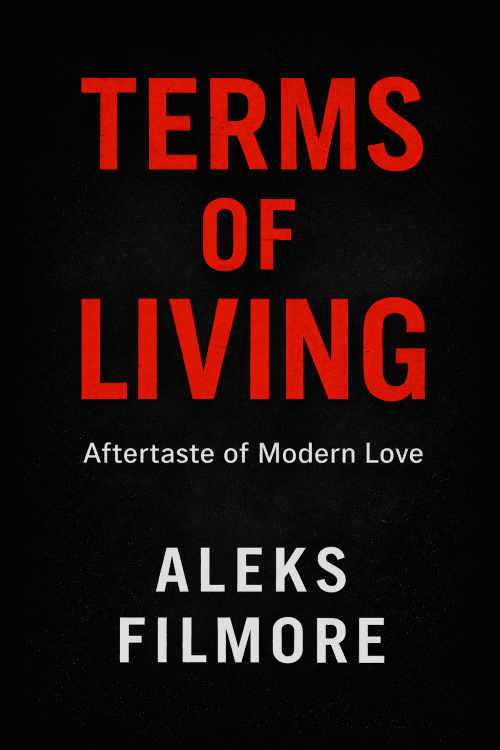
Terms of Living
A breakup concludes calmly. Language behaves. Dignity remains intact. The following morning, the room looks the same. The body does not. What follows is not collapse but residue: the habits that linger, the monitoring that continues, and the quiet search for proof that nothing has shifted.
Set in a coastal winter town, this memoir traces the silent psychological movement through five distinct phases: detonation, vacancy, circulation, reconstruction, and revision. Filmore maps how early rooms trained vigilance, how modern app dating turns desire into transaction, and how devotion can resemble surveillance when left unchecked.
Rather than offering prescriptions, the book observes mechanics: how attachment forms, how it persists, and how it recalibrates. A literary account of unlearning the reflex to shrink—about the work that begins once the drama ends and the room stays quiet long enough for you to hear yourself again.
- Memoir with a continuous narrative spine
- Intimacy examined without redemption theater
- Cultural commentary embedded in lived scenes
- Sentences that stay sharp under emotional pressure
The Five Movements.
A structured diagnostic tracking the internal calibration that occurs when a partnership dissolves with all words accounted for, but the nervous system refuses to lie.
Detonation
The conclusion, and the immediate malfunction. When language behaves perfectly while the internal telemetry crashes.
The Void
Time with no instructions. The silent shock of quiet rooms and the phantom reflex to maintain surveillance.
The Marketplace
The economy that forms around heartbreak. Apps, algorithmic reassurance, and the transactional choreography of modern dating.
Becoming
A new internal order, assembled slowly. The deliberate work of unlearning the reflex to shrink and accommodate.
Terms of Living
The settlement. The terms that hold when you return to ordinary life with reality matched instead of managed.
“Two editors told me the ending had no lift. I kept it. A stitch is a repetition that cannot be undone by wanting it undone.” — Aleks Filmore, From the origin essay ‘Save As’
Terms of Living began as a series of forensic field notes written in the months following a quiet rupture. The complete origin essay explores the mechanics of version history, relational credit, and the decision to stop running.
Read Origin Essay: "Save As"Reader Response.
Observations from verified readers encountering the psychological precision of the text.
“It just shows how it works. Calm, precise, and uncomfortable in an honest way.”
“This felt very specific to me as a gay reader. The marketplace view of modern dating was spot on.”
“Soft breakup, hard reality. Finally articulated thoughts I couldn’t put into words.”
“A mirror of one’s own dating life. Both analytical and deeply emotional at the exact same time.”
“Engaging and well-paced... thought-provoking exploration of what lingers after love ends.”
“Terms of Living is what happens after the argument ends—when dignity stays intact but the body keeps the score.”
Technical Dossier.
The Heartbreak Canon.
A three-movement forensic investigation into toxic attachment, aftermath, and self-interrogation.
The Worst Boyfriends Ever
The wreckage. Twenty-five dating trainwrecks examined under clinical light to understand why we stay in catastrophic patterns.
Terms of Living
The settlement. What lingers in the body and habits when a relationship ends calmly on paper but the nervous system refuses to lie.
Am I the Red Flag?
The mirror. The uncomfortable questions we avoid asking about our own participation and defense mechanisms.
Terms of Living © 2026 Aleks Filmore. All rights reserved.
Registered with the U.S. Copyright Office as a literary work (Claim No. 1-15120633951).
Protected under U.S. copyright law and the Berne Convention for the Protection of Literary and Artistic Works.
No part of this work or digital adaptation may be used to train, fine-tune, or develop any artificial intelligence or machine learning system without the express written permission of the author.